Press
2016
Robert C. Morgan | Art Critic
Wheiza Kim at Gallery D’Arte
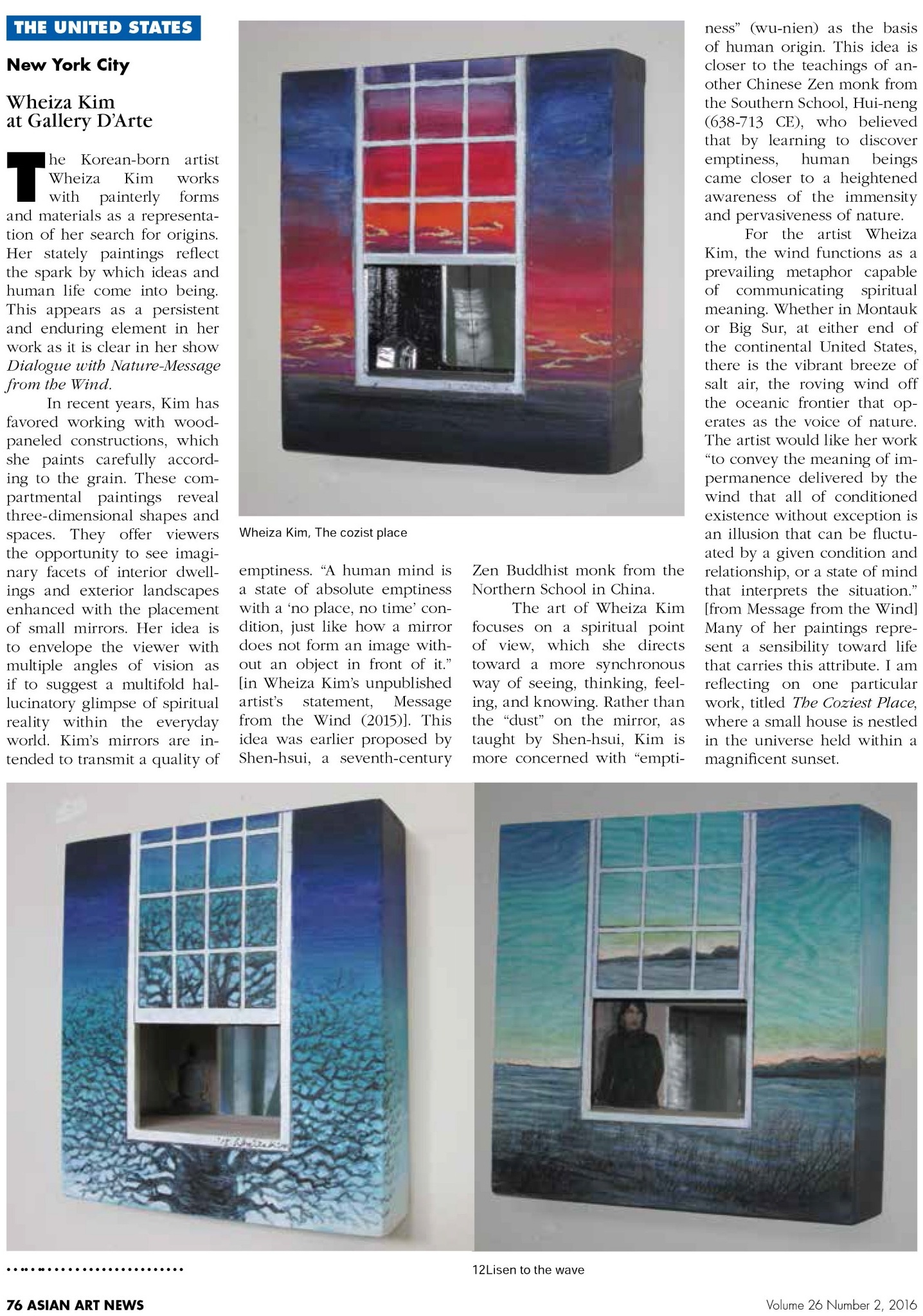
The Korean-born artist Wheiza Kim works with painterly forms and materials as a representation of her search for origins. Her stately paintings reflect the spark by which ideas and human life come into being. This appears as a persistent and enduring element in her work as it is clear in her show 《Dialogue with Nature-Message from the Wind》.
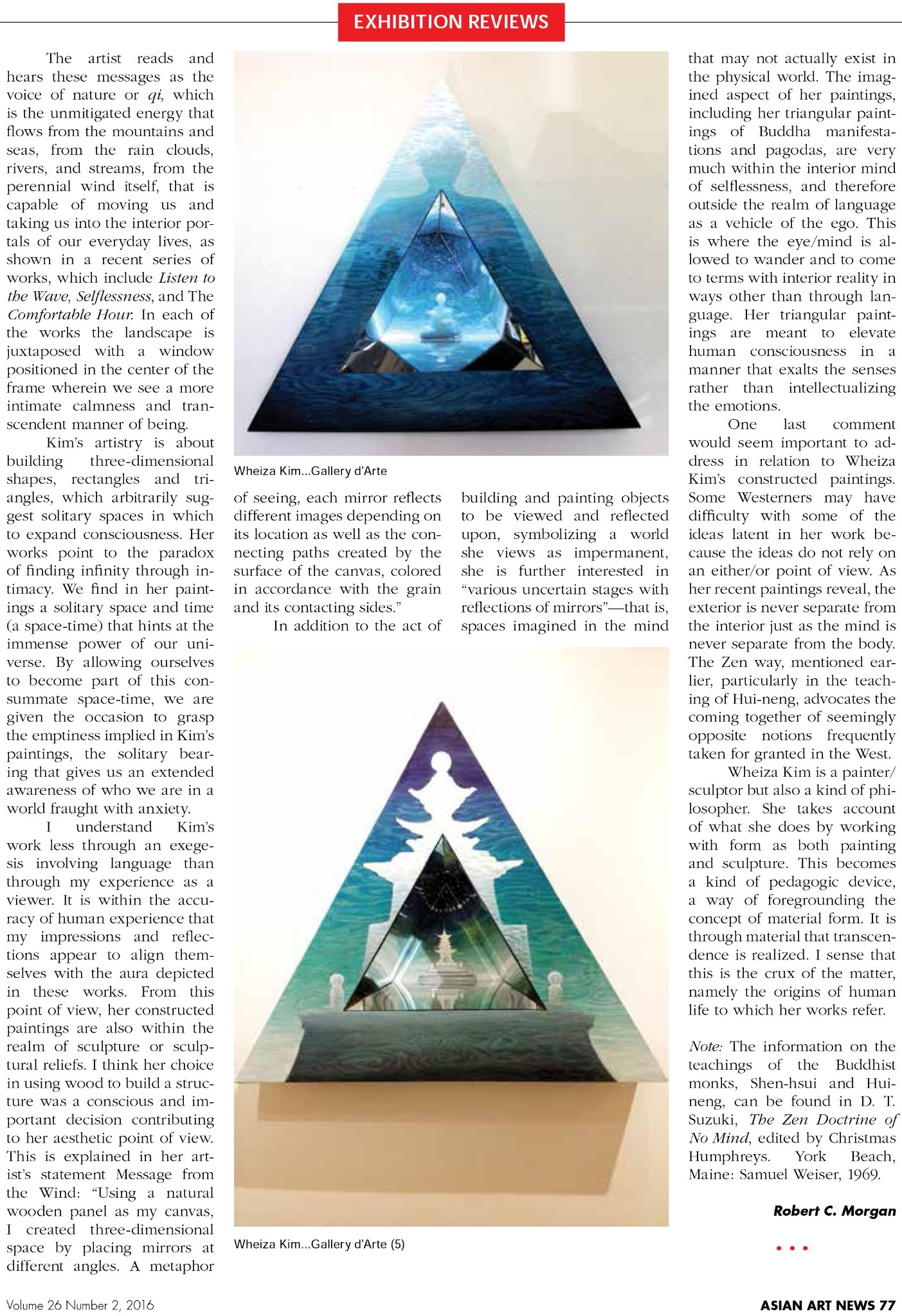
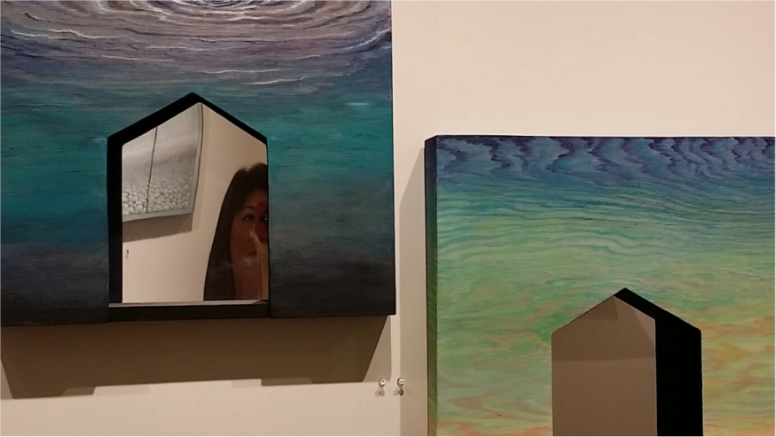
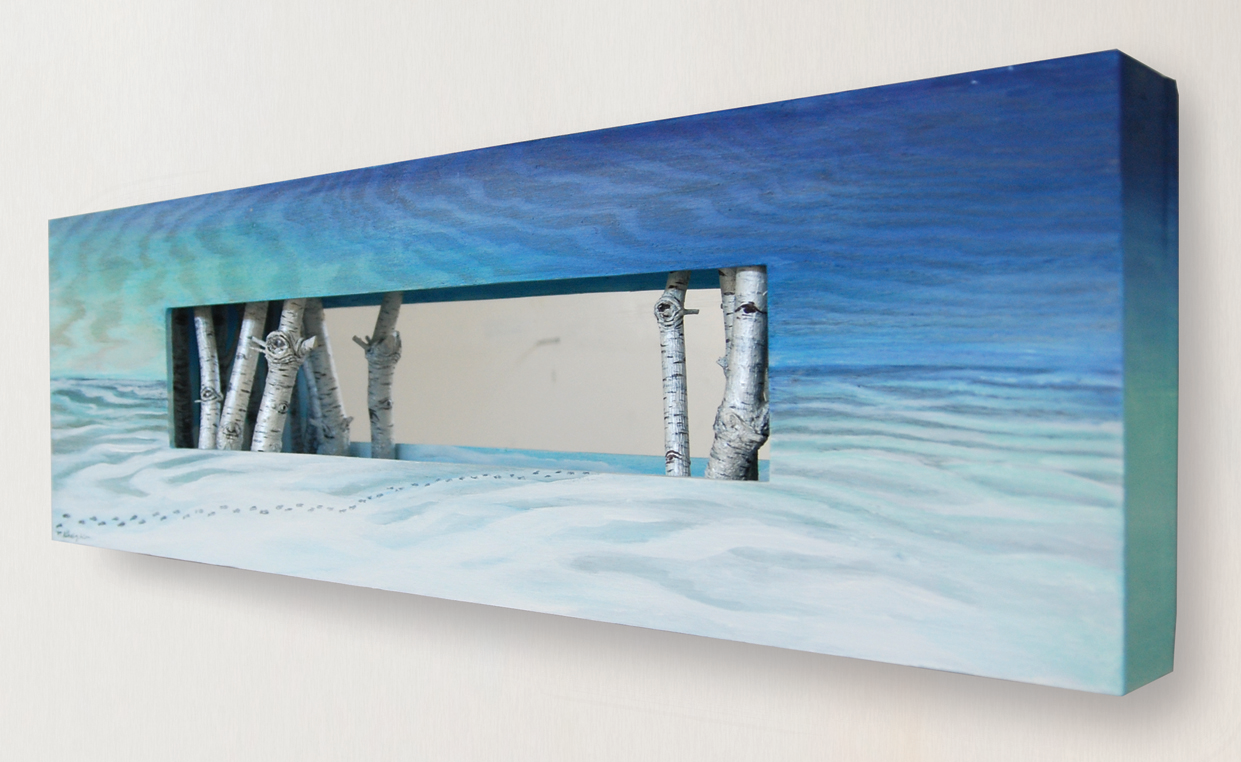
In recent years, Kim has favored working with wood-paneled constructions, which she paints carefully according to the grain. These compartmental paintings reveal three-dimensional shapes and spaces. They offer viewers the opportunity to see imaginary facets of interior dwellings and exterior landscapes enhanced with the placement of small mirrors.
Her idea is to envelope the viewer with multiple angles of vision as if to suggest a multifold hallucinatory glimpse of spiritual reality within the everyday world. Kim’s mirrors are intended to transmit a quality of emptiness. “A human mind is a state of absolute emptiness with a ‘no place, no time’ condition, just like how a mirror does not form an image without an object in front of it.” [in Wheiza Kim’s unpublished artist’s statement, Message from the Wind (2015)]. This idea was earlier proposed by Shen-hsui, a seventh-century Zen Buddhist monk from the Northern School in China.
The art of Wheiza Kim focuses on a spiritual point of view, which she directs toward a more synchronous way of seeing, thinking, feeling, and knowing. Rather than the “dust” on the mirror, as taught by Shen-hsui, Kim is more concerned with “emptiness” (wu-nien) as the basis of human origin. This idea is closer to the teachings of another Chinese Zen monk from the Southern School, Hui-neng (638-713 CE), who believed that by learning to discover emptiness, human beings came closer to a heightened awareness of the immensity and pervasiveness of nature.
For the artist Wheiza Kim, the wind functions as a prevailing metaphor capable of communicating spiritual meaning. Whether in Montauk or Big Sur, at either end of the continental United States, there is the vibrant breeze of salt air, the roving wind off the oceanic frontier that operates as the voice of nature.
The artist would like her work “to convey the meaning of impermanence delivered by the wind that all of conditioned existence without exception is an illusion that can be fluctuated by a given condition and relationship, or a state of mind that interprets the situation.” [from Message from the Wind] Many of her paintings represent a sensibility toward life that carries this attribute. I am reflecting on one particular work, titled The Coziest Place, where a small house is nestled in the universe held within a magnificent sunset.
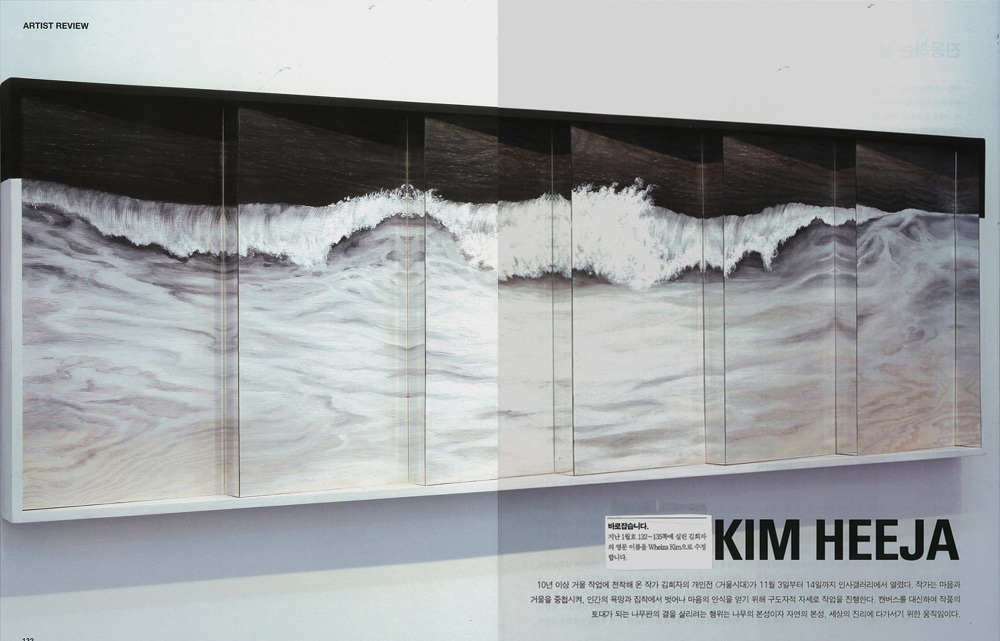
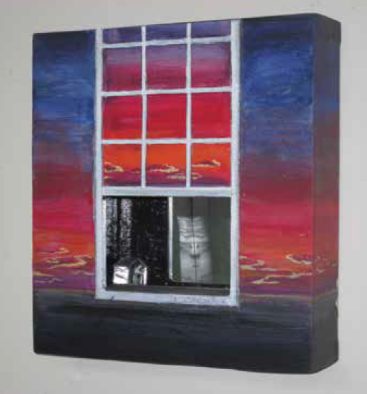
The artist reads and hears these messages as the voice of nature or qi, which is the unmitigated energy that flows from the mountains and seas, from the rain clouds, rivers, and streams, from the perennial wind itself, that is capable of moving us and taking us into the interior portals of our everyday lives, as shown in a recent series of works, which include Listen to the Wave, Selflessness, and The Comfortable Hour. In each of the works the landscape is juxtaposed with a window positioned in the center of the frame wherein we see a more intimate calmness and transcendent manner of being.
Kim’s artistry is about building three-dimensional shapes, rectangles and triangles, which arbitrarily suggest solitary spaces in which to expand consciousness. Her works point to the paradox of finding infinity through intimacy. We find in her paintings a solitary space and time (a space-time) that hints at the immense power of our universe. By allowing ourselves to become part of this consummate space-time, we are given the occasion to grasp the emptiness implied in Kim’s paintings, the solitary bearing that gives us an extended awareness of who we are in a world fraught with anxiety.
I understand Kim’s work less through an exegesis involving language than through my experience as a viewer. It is within the accuracy of human experience that my impressions and reflections appear to align themselves with the aura depicted in these works. From this point of view, her constructed paintings are also within the realm of sculpture or sculptural reliefs. I think her choice in using wood to build a structure was a conscious and important decision contributing to her aesthetic point of view.
This is explained in her artist’s statement Message from the Wind: “Using a natural wooden panel as my canvas, I created three-dimensional space by placing mirrors at different angles. A metaphor of seeing, each mirror reflects different images depending on its location as well as the connecting paths created by the surface of the canvas, colored in accordance with the grain and its contacting sides.”
In addition to the act of building and painting objects to be viewed and reflected upon, symbolizing a world she views as impermanent, she is further interested in “various uncertain stages with reflections of mirrors”—that is, spaces imagined in the mind that may not actually exist in the physical world.
The imagined aspect of her paintings, including her triangular paintings of Buddha manifestations and pagodas, are very much within the interior mind of selflessness, and therefore outside the realm of language as a vehicle of the ego. This is where the eye/mind is allowed to wander and to come to terms with interior reality in ways other than through language. Her triangular paintings are meant to elevate human consciousness in a manner that exalts the senses rather than intellectualizing the emotions.
One last comment would seem important to address in relation to Wheiza Kim’s constructed paintings. Some Westerners may have difficulty with some of the ideas latent in her work because the ideas do not rely on an either/or point of view. As her recent paintings reveal, the exterior is never separate from the interior just as the mind is never separate from the body. The Zen way, mentioned earlier, particularly in the teaching of Hui-neng, advocates the coming together of seemingly opposite notions frequently taken for granted in the West.
Wheiza Kim is a painter/sculptor but also a kind of philosopher. She takes account of what she does by working with form as both painting and sculpture. This becomes a kind of pedagogic device, a way of foregrounding the concept of material form. It is through material that transcendence is realized. I sense that this is the crux of the matter, namely the origins of human life to which her works refer.
Note: The information on the teachings of the Buddhist monks, Shen-hsui and Hui-neng, can be found in D. T. Suzuki, The Zen Doctrine of No Mind, edited by Christmas Humphreys. York Beach, Maine: Samuel Weiser, 1969.
Robert C. Morgan