Press
2011.01
Cho Eun-jung | Art Critic
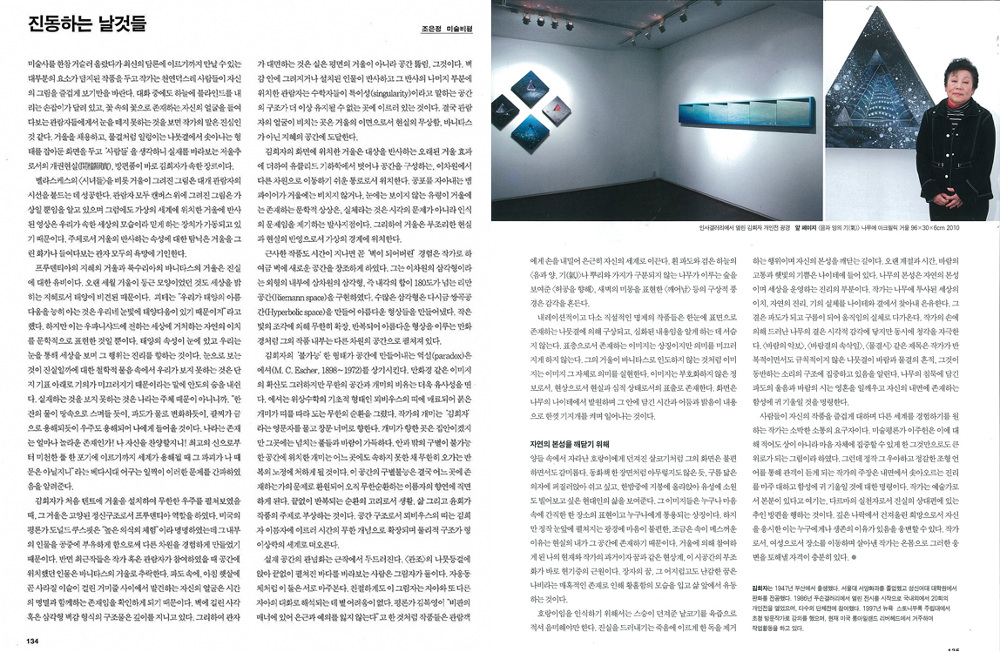
Faced with works that contain nearly every element through which one might travel far back into art history and arrive again at the latest contemporary discourse, the artist says with disarming ease that she merely hopes people will enjoy looking at her paintings. Even in conversation, she cannot take her eyes off the viewers who encounter a handle that seems to lower a blind across the sky or who peer at their own faces existing as a flower within a flower. Her words therefore seem sincere.
Employing mirrors, capturing forms that rise out of wood grain undulating like waves, thinking of “people,” or using actual reality as the counterweight from which to view things—this conceptual reality, opening the provisional to reveal the real (開權顯實, from the “Expedient Means” chapter), is precisely the territory to which Wheiza Kim belongs.
Paintings containing mirrors, from Velázquez’s Las Meninas onward, generally succeed in capturing the viewer’s gaze. Viewers know that the painting on the canvas is an illusion, yet within the painted world another mechanism is activated: the image reflected in the mirror appears to belong to the world in which we ourselves exist. This fascination with the reflective property of the mirror as subject derives from the desires of both the painter who depicts the mirror and the viewer who looks into it.
Plotinus’s mirror of wisdom and Lucia’s mirror of vanitas are analogies for truth. The fact that mirrors were for centuries circular in form was also due to their being compared to the sun as an illuminating form of wisdom. Goethe wrote, “We are able to recognize the beauty of the sun because there is something sun-like in the light of our eyes.” Yet this is no more than a literary expression of the natural order that, according to the Upanishads, inhabits the world.
The attribute of the sun is present in the eye; through our eyes we see the world, and that act is directed toward truth. Amid the philosophical question of whether what we see is truly real, we find a certain relief in the claim that what escapes our vision does so merely because the signified has slipped beneath the signifier. Is our failure to see what actually exists perhaps the consequence of the subject called “I”?
A passage from the Vedantic period suggests that this problem had already been perceived long ago: “As a cup of water sinks into the earth, as a wave becomes water, as a bracelet melts into gold, the universe too will dissolve and enter into me. What a wondrous being I am! Let me praise myself! When the world, from the highest god to the humblest blade of grass, dissolves, may that destruction not be because of me.”
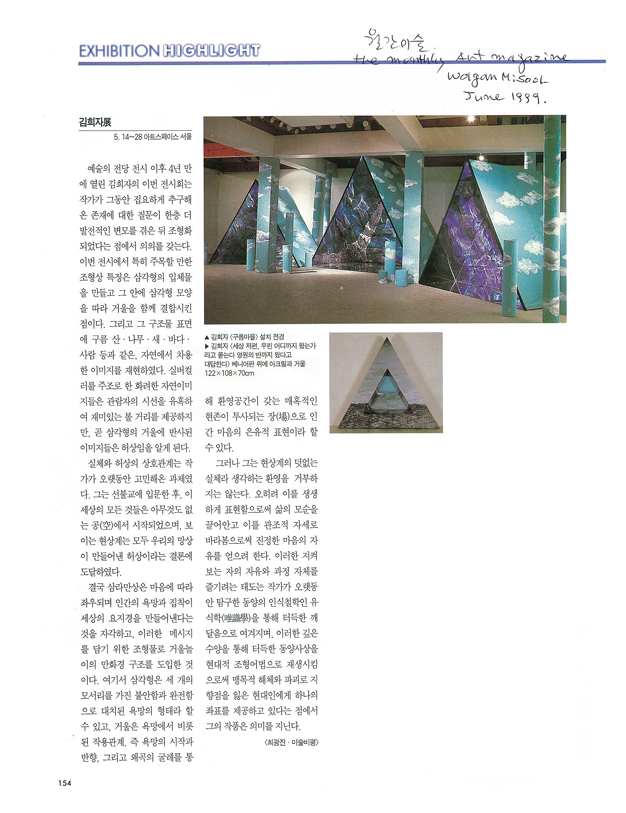
When Wheiza Kim first installed mirrors inside a tent and unfolded an infinite universe, the mirror functioned as Prudentia, a structure of elevated consciousness. The American critic Donald Kuspit called it an “experience of higher consciousness,” because the figure inside was made to float in the air and thereby experience another dimension.
In more recent works, however, the figure seen in the mirror through the participation of the artist or the viewer descends into the mirror of vanitas. The face discovered among waves, or amid spider webs strung with dew that will soon disappear in the morning sunlight, confirms one’s existence as something subject to the flickering appearance and disappearance of time.
Square or triangular niche-like structures mounted on the wall acquire depth. What the viewer confronts is therefore not a physical flat mirror but an opening in space itself. A figure painted or installed within the niche is reflected, while the viewer positioned in the remainder of the reflection arrives at what mathematicians call a singularity—a point at which the existing structure of space can no longer be maintained. Ultimately, the place where the viewer’s face appears is the reverse side of the mirror, arriving not at the vanitas of reality’s impermanence but at a space of wisdom.
The mirror positioned within Wheiza Kim’s pictorial field goes beyond the age-old function of reflecting objects. It occupies the role of a passage that constructs space beyond Euclidean geometry, enabling movement from two dimensions into another dimension.
The literary imagination that something may exist within the mirror while remaining invisible or unreflected—within a mirror that serves as the framework generating space—becomes a point of departure for recognizing that actuality is not simply a problem of vision but of perception. The mirror thus stands at the boundary between absurd reality and the virtual as reality’s reflection.
The experience of seeing even a remarkable work of art eventually “become a star” prompted the artist to create a new space on the wall. Within the exterior form of a two-dimensional triangle, she realizes a three-dimensional triangle—in other words, a Riemannian space whose interior angles exceed 180 degrees.
Countless triangles in turn form hyperbolic spaces and generate beautiful configurations. Like a kaleidoscope in which fragments of light infinitely expand and repeat to form beautiful images, the interior of her works opens into a different dimensional space.
The paradox produced in space by Wheiza Kim’s “impossible” forms recalls M. C. Escher (Maurits Cornelius Escher, 1898–1972). The kaleidoscopic proliferation of images bears a similarity, but the analogy between infinite space and ants makes the affinity still clearer. Escher, fascinated by the Möbius strip, a fundamental topological form, depicted red ants following its endless circulation. Kim’s ant carries the English letters spelling “Wheiza Kim” and heads beyond a window.
The ant may be heading indoors, yet the place is filled with overflowing plants and wind. Situated in a space where inside and outside cannot be distinguished, the ant will remain unable to belong to either, endlessly moving back and forth along a repetitive route.
This indistinguishability of space ultimately returns to the question of where one exists, confronting us with a feast of letters caught in perpetual circulation. Life, living, and reincarnation thus emerge as themes structured around an endlessly repeating cycle. As a spatial structure, the Möbius strip expands through the letters of Wheiza Kim’s name into an infinite concept of time, allowing a physical structure to rise into the realm of metaphysics.
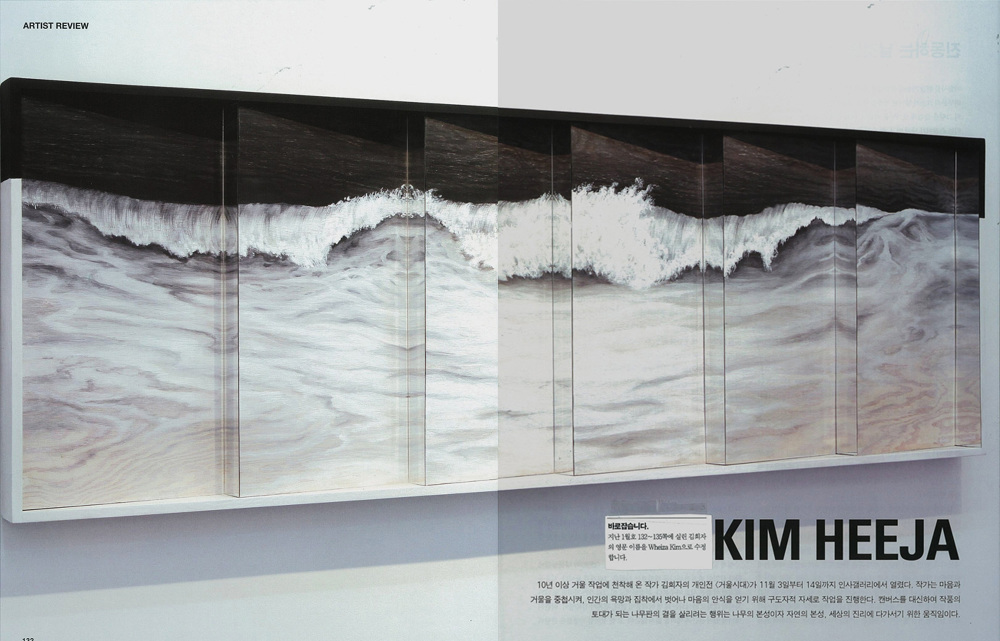
The conceptualization of actual space becomes especially pronounced in her recent works. In Contemplation, a person seated on a tree stump and gazing at an endlessly unfolding sea casts two shadows. Like an androgynous being, the two face one another. The scene is readily interpretable as a dialogue between nature and another self. As critic Kim Bok-young once observed that the works “do not lose subtlety and decorum even in their manner of pessimism,” these works extend a hand toward the viewer and gently lead one into the artist’s world. Constructed landscapes such as Chi, Yin and Yang, with its white waves and black sky; Toward the Void, showing a forest composed of trees whose roots and branches can no longer be distinguished; and Awakening, expressing the haziness of dawn, unsettle the senses.
Works with narrative and somewhat direct propositions do not hesitate to make clear that they are conceived through the wood grain existing visibly on the surface and that deeper content lies within. The image existing as surface is symbolic, but it does not cause meaning to slip away. Just as the artist’s mirror does not lead toward vanitas, the image realizes meaning as image itself. It exists as unencoded information: both as phenomenon and reality, and as the expression of a psychological state. The pictorial field originates in the tree’s growth rings, and the time, darkness, and brightness contained within them rise vividly as content.
To Realize the True Nature of Nature
Like raw meat thrown to a tiger raised among sheep, her pictorial field is at once unsettling and seductive. With an apparent casualness reminiscent of a page from a children’s storybook, it depicts the life of contemporary people who wish to sprawl and rest upon a cloud-like chair, climb onto a gently shimmering roof, and make a wish upon a meteor. The image expresses a place that exists in the mind and functions as a symbol available to anyone.
Yet the reason the scene unfolding before one’s eyes feels uncomfortable, even slightly nauseating, is that the real “I” exists within that space. The disjunction between my present captured by the mirror and the artist’s past—an phenomenal world resembling a dream—is the source of this dizziness. The artist’s dream, bewildering and difficult as it may be, takes on an ecstatic appearance through the enchanting presence of the butterfly and floats before life.
To recognize that one is a tiger, one must taste and savor the raw meat thrown by the master, soaked in its juices. Revealing truth is an act of removing poison that leads toward death, and it is a path toward awakening to one’s own nature. The seasons and time contained in a tree, the suffering of wind and the joy of sunlight, reside within its growth rings. The nature of the tree is the nature of nature itself, and part of the truth by which the world operates. The artist seeks out and metaphorically articulates the principles of the world projected onto the tree, the truth of nature, and the substance of memory within its growth rings and grain.
That grain becomes waves and clouds, approaching us as the very substance of movement. Revealed through the artist’s hand, the wood grain touches the visual senses while simultaneously stimulating the auditory. Titles such as Flattery of the Wind, The whisper of a breeze, and The poetry of waves indicate the artist’s focus on irregular yet repetitive wood grain as traces of wind and waves, and on the sonic structures accompanying them. The cry of waves and the poetry of wind embedded in the silence of wood awaken the spirit and command us to listen to the resonances existing within ourselves.
The artist, who wishes people to encounter her works joyfully and experience another world, is fundamentally someone who demands communication. Lee Joong-hyun remarked that, at the very least, these are paintings that offer considerable consolation simply by allowing us to focus not on the distance between self and other but on the mind itself. Yet through this elegant and restrained formal language, what the viewer actually hears is the artist’s imperative: confront the truth rising from within and listen to its resonance.
Believing that an artist has a proper calling, she acts as a practitioner of dharma, directing us toward expedient means situated opposite the truth. One who has gazed at oneself through hope raised from the deepest abyss can proclaim that everyone has a reason to survive. Having lived as both an artist and a woman while moving from place to place, she has fully earned the right to make such a proclamation with her entire body.
Wheiza Kim: Born in Busan in 1947, Kim graduated from the Department of Western Painting at Seoul National University and studied printmaking at the Graduate School of Sungshin Women’s University. Since her exhibition at Dooson Gallery in 1986, she has held 20 solo exhibitions in Korea and abroad and has participated in numerous group exhibitions. In 1997, she taught as an invited visiting artist at Stony Brook University in New York. She currently lives and works in Riverhead, Long Island, New York.