Press
June, 1999
Monthly Art | Choi Gwang-jin, Art Critic
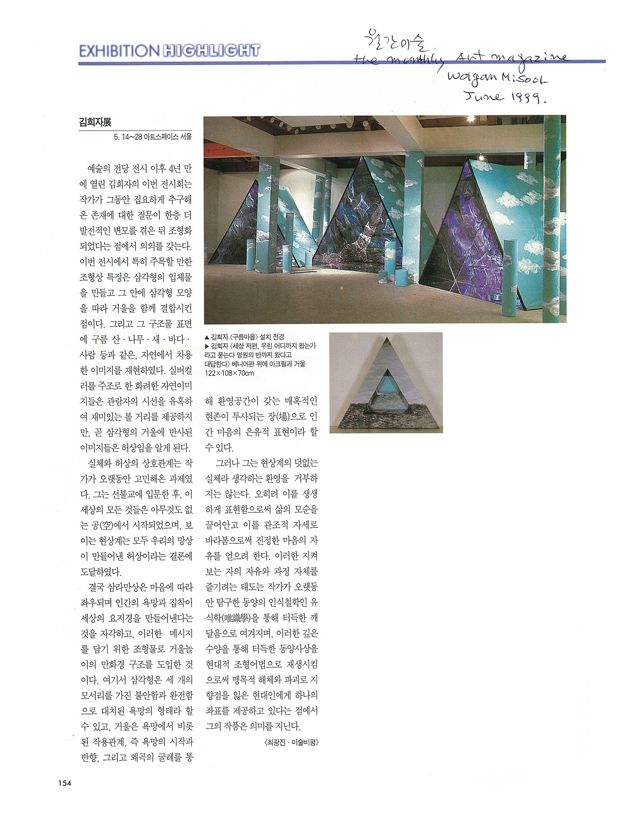
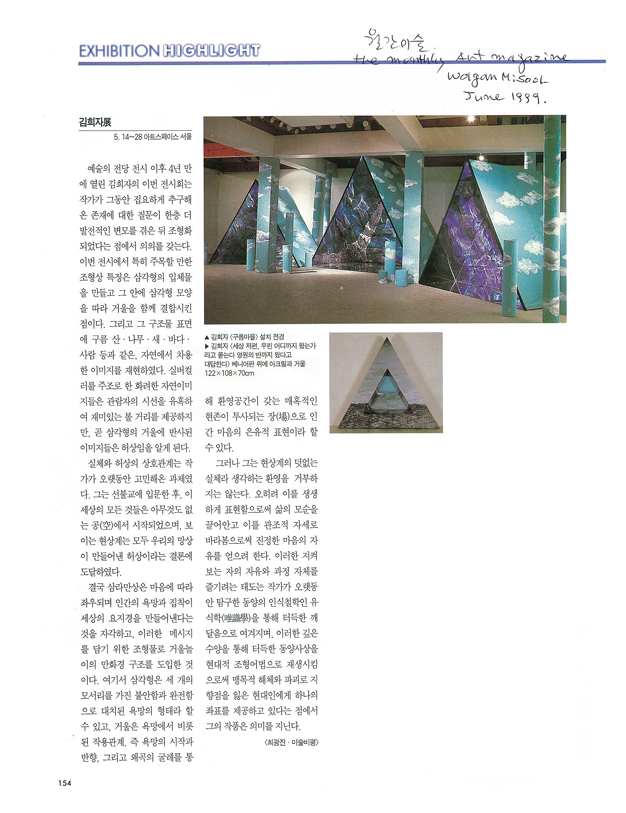
This exhibition by Wheiza Kim, held four
years after her exhibition at the Seoul Arts Center, is significant in that the
questions concerning existence, which the artist has persistently pursued, have
undergone further development and found expression in sculptural form. A
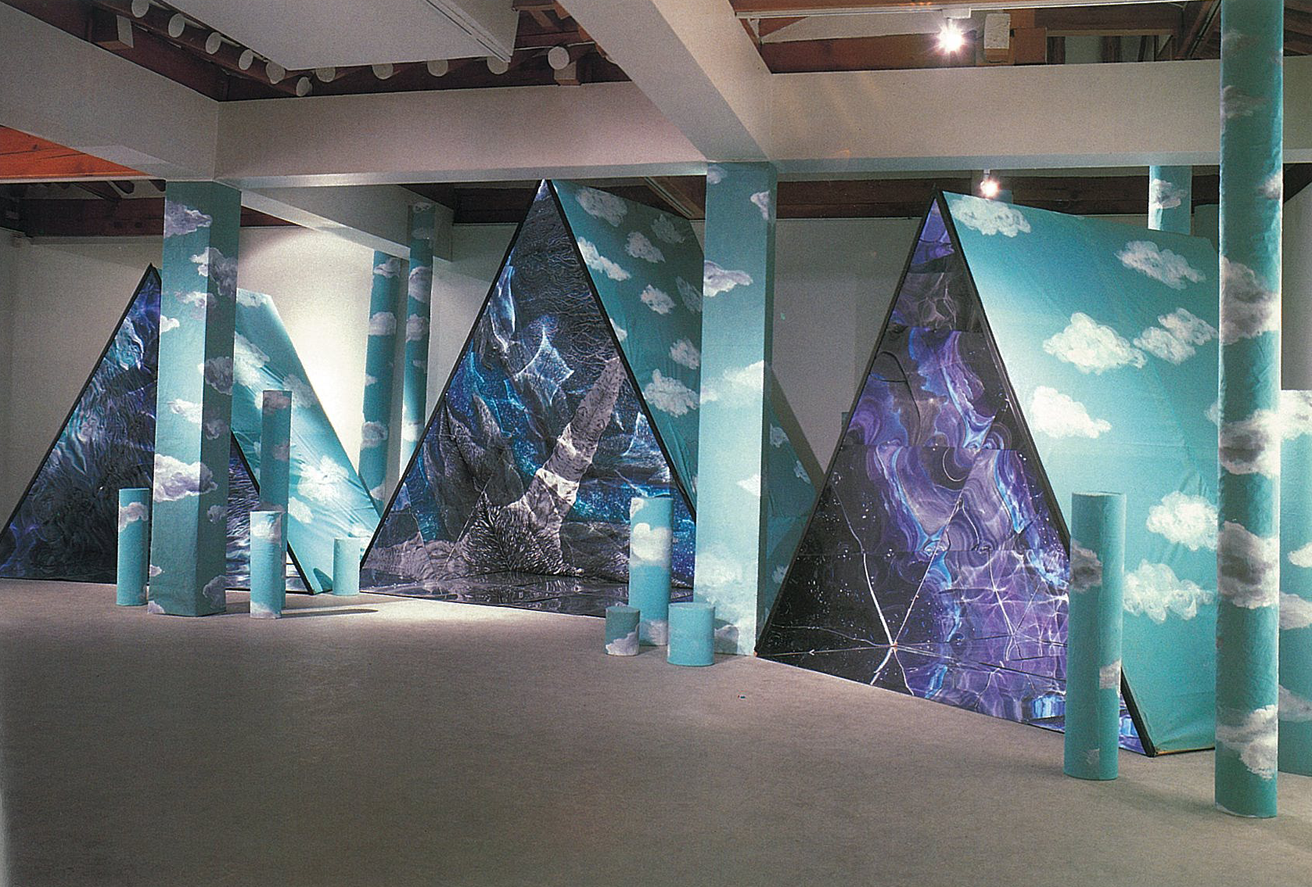
particularly noteworthy formal characteristic of this exhibition is the
construction of three-dimensional triangular structures incorporating mirrors
arranged along their triangular interiors. On the surfaces of these structures,
Kim depicts images drawn from nature, including clouds, mountains, trees,
birds, the sea, and human figures. These elaborate natural images,
predominantly rendered in silver tones, attract the viewer's gaze and offer an
engaging visual experience. Yet viewers soon come to recognize that the images
reflected in the triangular mirrors are mere illusions.
The relationship between reality and
illusion has long been a central concern in Kim's artistic practice. After
encountering Zen Buddhism, she came to the conclusion that everything in the
world originates from emptiness (空), a state of
nothingness, and that the visible phenomenal world consists of illusory
appearances produced by our own delusions.
Ultimately, Kim came to recognize that the
myriad manifestations of the world are conditioned by the mind, and that human
desire and attachment create the kaleidoscopic illusions of worldly existence.
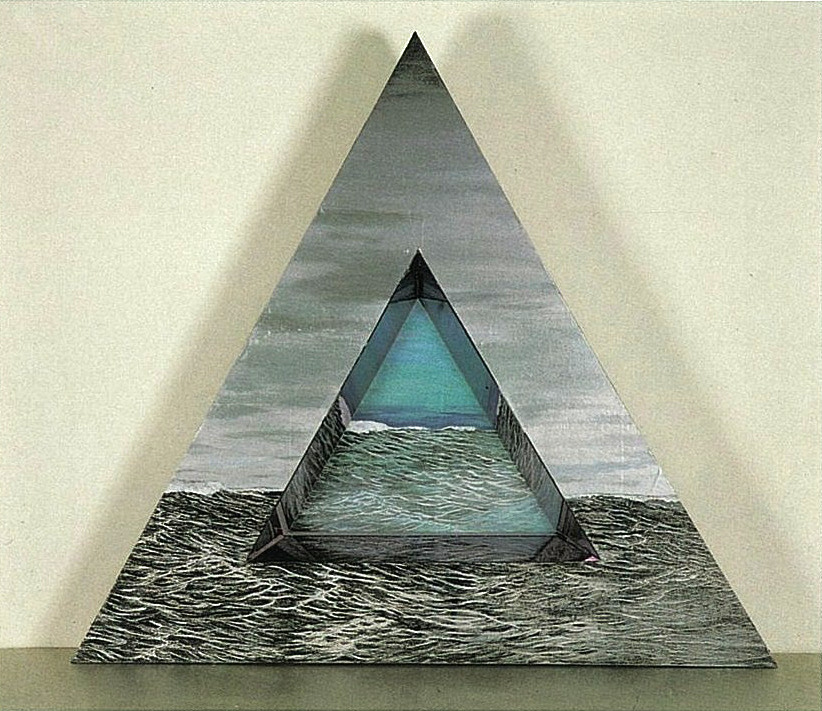
To convey this understanding, she adopted the structure of a kaleidoscope,
using mirrors as a central element of her sculptural compositions. Here, the
triangle, with its three vertices, may be understood as a form of desire in
which instability and perfection stand in opposition. The mirror, meanwhile, serves
as a metaphorical expression of the human mind: a field onto which the
captivating presence of an illusory space is projected through the interplay of
desire, its emergence and reverberation, and the recurring cycle of distortion.
Kim, however, does not reject the illusions
that she regards as the transient reality of the phenomenal world. Rather, by
rendering them vividly, she seeks to embrace the contradictions of life and
attain genuine freedom of mind through contemplative observation. This attitude
of enjoying both the freedom of the observer and the process of observation
itself may be understood as an insight gained through her longstanding
engagement with Yogācāra philosophy (唯識學), the Buddhist tradition
concerned with the nature of consciousness and perception. By reinterpreting
the Eastern philosophical thought she has cultivated through sustained
spiritual discipline in a contemporary visual language, Kim's work offers a
point of orientation for modern individuals who have lost their sense of
direction amid indiscriminate deconstruction and destruction. It is in this
respect that her work acquires its significance.